The Evolution of 8K Video Delivery
07.12.2026Miles Lopez
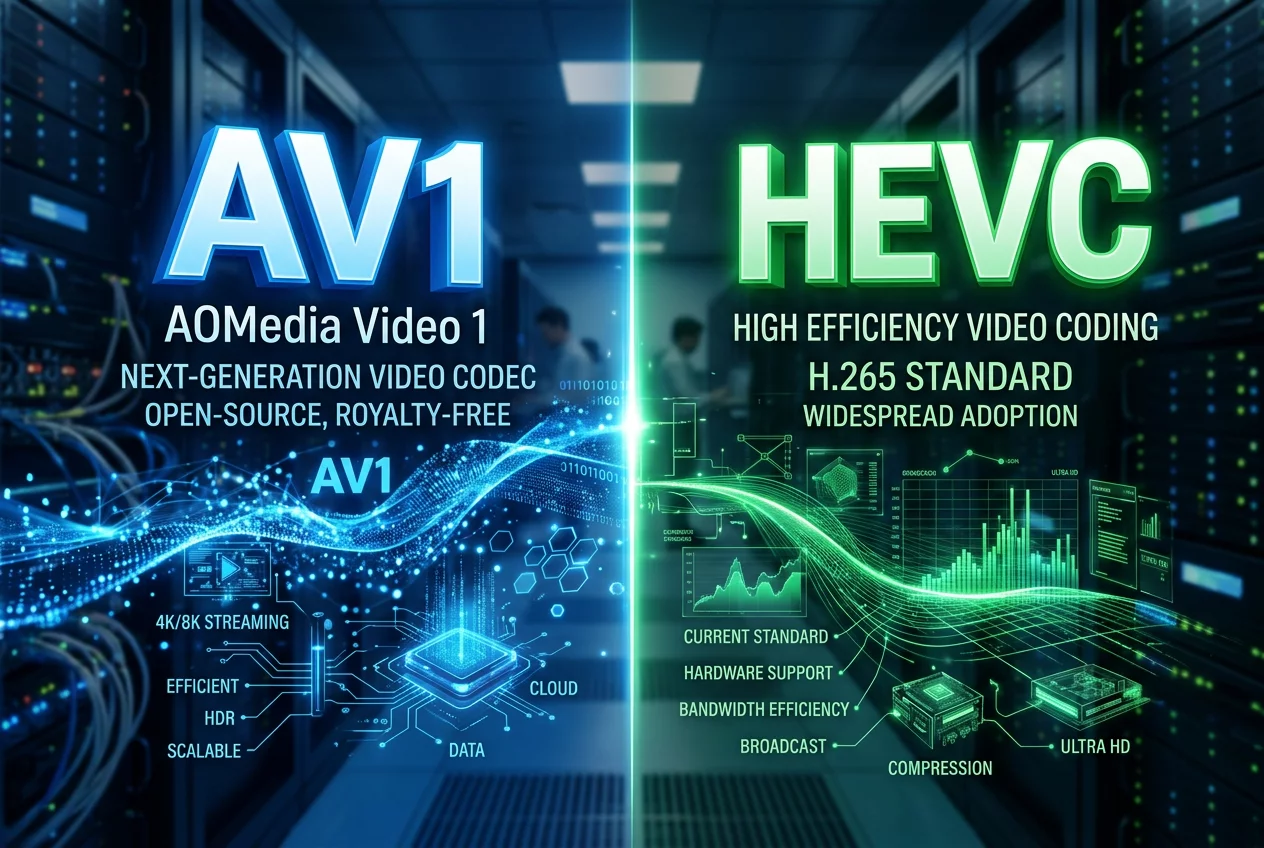
The streaming industry currently sits at a crossroads between two dominant video codecs: HEVC and AV1. Both technologies aim to deliver high-quality video at lower bitrates, yet they follow very different paths to achieve this goal. HEVC, or H.265, emerged as the successor to the widely used H.264, offering significant improvements in data efficiency. It has seen widespread adoption in hardware, from smartphones to smart TVs. On the other side, AV1 stands as an open-source, royalty-free alternative developed by the Alliance for Open Media. This project includes tech giants who seek to avoid the complex licensing fees associated with HEVC. Turnexedic supports both formats, recognizing that the choice often depends on the specific needs of the broadcaster and the capabilities of the audience's hardware.
AV1 generally provides superior compression compared to HEVC, often reaching 20% to 30% better efficiency for the same visual quality. This advantage proves crucial for 4K and 8K streaming, where every saved megabit translates to lower costs and smoother playback. However, this efficiency comes at a price. The encoding complexity for AV1 is significantly higher, requiring more computational power and time. In it, the algorithms perform deeper searches for motion vectors and use more complex intra-prediction modes. HEVC benefits from years of hardware optimization, making it the faster choice for real-time applications like live sports. Most modern graphics cards include dedicated circuits for HEVC encoding, whereas hardware support for AV1 is still catching up across the consumer market.
The most significant divide between these codecs lies in their legal and financial structures. HEVC operates under a patent pool system, which requires manufacturers and some content providers to pay royalties. This structure has historically slowed its adoption in web browsers and open-source software. AV1 removes these barriers, making it an attractive option for platforms that serve billions of hours of video. This royalty-free nature encourages innovation among smaller developers who might otherwise be priced out of high-end video delivery. Follow these guidelines when choosing a codec for your project:
When bitrates drop to their lowest levels, the two codecs behave differently. HEVC tends to maintain sharp edges but may introduce blocking artifacts in dark or complex areas of the frame. AV1 often employs a sophisticated film grain synthesis technique, which adds a natural-looking texture to the video, masking compression artifacts. This makes AV1 particularly popular for cinematic content where preserving the 'film look' is important. Inside the transcoding engine, parameters are adjusted to balance these traits. The software analyzes the texture of the source material and selects the prediction mode that best preserves the original intent. For high-motion content, HEVC sometimes holds a slight edge in stability, while AV1 excels in static, high-detail scenes.
The industry likely moves toward a multi-codec future rather than a winner-take-all scenario. Many platforms already serve HEVC to Apple devices and AV1 to Android and desktop users. This hybrid approach maximizes compatibility while taking advantage of the best compression available for each platform. As hardware manufacturers integrate more AV1 decoders into their chips, the computational hurdle for AV1 will diminish. Meanwhile, newer standards like VVC (Versatile Video Coding) are already appearing on the horizon, promising even better performance. Turnexedic remains committed to providing flexible tools that adapt to these shifting standards, ensuring that content providers can always reach their audience with the highest possible quality.

Turnexedic is a software provider focused on media processing technology. We offer tools for video transcoding, helping businesses manage digital content efficiently. Our platform supports various formats and delivery standards globally.